
Gambling Harm in Australia: The Signs, the Numbers and Where to Get Help

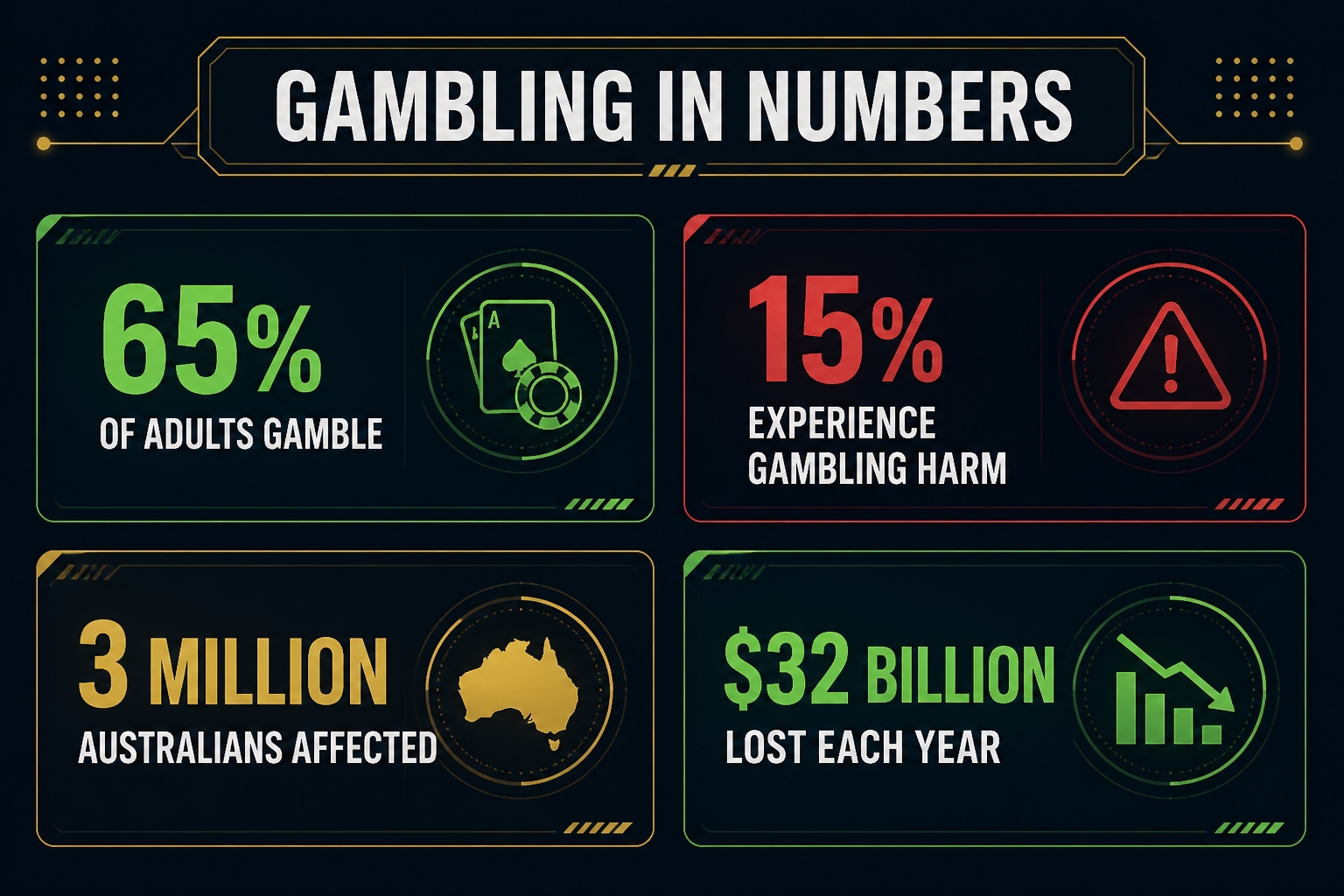
Fifteen per cent of Australian adults — roughly 3 million people — experienced gambling harm in the past 12 months, up from 11 per cent in 2019 (Australian Broadcasting Corporation [ABC] 2025). Harm here means measurable damage: stress, borrowing money, skipping meals or selling possessions to fund betting (ABC 2025). This page collects the signs, the statistics behind the section's legal mission, and the services that work.
What the 2025 National Study Found
Quantification principle. The Australian Gambling Research Centre surveyed 3,881 adults: participation rose from 57 to 65 per cent between 2019 and 2024; harm rose from 11 to 15 per cent; 7.7 per cent of monthly gamblers were high-risk; adults aged 18–24 were nearly twice as likely as other groups to be high-risk. Prevalence by state ran from 70.2 per cent in Queensland to 59.9 per cent in Tasmania (ABC 2025). The money follows the harm: Australians lose about $32 billion on legal gambling each year, roughly $1,635 per adult — the highest per-capita losses in the world (Australian Institute of Family Studies [AIFS] 2025; ABC 2025).
Recognising the Signs
Gambling "starts for the thrill", lead author Dr Gabriel Tillman told the ABC, then "starts turning into a behavioural addiction paradigm, or a genuine way to make money" (ABC 2025). The observable signs map to concrete first actions:
| Sign | What it looks like | First action |
|---|---|---|
| Borrowing to bet | Loans, buy-now-pay-later, payroll advances | Helpline 1800 858 858 + BetStop registration guide |
| Funding bets by sacrifice | Skipping meals, selling possessions (ABC 2025) | Free counselling via the helpline |
| Stress and mental load | Sleep, mood, concentration | GP review + helpline |
| Chasing losses offshore | Deposits with unlicensed casinos | Recovery protocol + report the site |
Recovery Is Ordinary
Lived-experience advocate Shayne Rodgers grew up where "gambling was discussed daily" — racing syndicates and TattsLotto in the household. His betting became a problem at 18; he sought help in his late twenties, when he could not afford fuel for his car, and has not gambled for more than a decade (ABC 2025). The decade between noticing the problem and seeking help is the interval that prevention policy — advertising limits, the BetStop register, the helpline — is built to shorten (author's observation).
Where Help Is Free and Immediate
Gambling Help Online on 1800 858 858 provides free, confidential counselling 24 hours a day (Australian Communications and Media Authority [ACMA] 2026b). BetStop is the structural tool: 67,480 registrations by July 2026 make it the most-used protection in the market (ACMA 2026c); a support person can be nominated and is notified of any removal application (ACMA 2026b).
Expert counsel. Harm travels beyond the gambler: the national study associates high-risk gambling with intimate partner violence, financial hardship and mental health conditions (ABC 2025). Nominating a support person in BetStop builds one layer of accountability into the register process (ACMA 2026b).
FAQ
How common is gambling harm in Australia?
Fifteen per cent of adults — about 3 million people — experienced gambling harm in 2024, up from 11 per cent in 2019 (ABC 2025).
Is help free?
Yes. Gambling Help Online on 1800 858 858 provides free, confidential counselling 24 hours a day (ACMA 2026b).
Can family act for someone who gambles?
BetStop registration is the individual's decision, but support people are notified of any removal application (ACMA 2026b); families can encourage registration and seek guidance through the helpline.
Sources
- Australian Broadcasting Corporation (ABC) 2025, Gambling participation and harm on the rise in Australia.
- Australian Communications and Media Authority (ACMA) 2026b, BetStop — the National Self-Exclusion Register.
- Australian Communications and Media Authority (ACMA) 2026c, Three years of BetStop, July 2026 (register data).
- Australian Institute of Family Studies (AIFS) 2025, National gambling study finds more Australians harmed amid rising participation.